

SCENIC
- Website: https://earthenvironment.helmholtz.de/changing-earth/innopool-projects/
- Co-PI & contact person: Dr. Benjamin Fersch, Prof. Dr. Harald Kunstmann
- Project scientist: Luca Glawion
- Project duration: 2022 – 2024
- Funding organization: Helmholtz Innopool Project
The SCENIC project develops and applies a novel modeling approach to explore how recent weather extremes would unfold in future climate scenarios and what they would be like in a pre-industrial climate. All Helmholtz Centers in the Research Field of Earth and Environment collaborate in SCENIC to tackle this question all the way from global modelling to concrete impacts that matter, with a special focus on Europe.
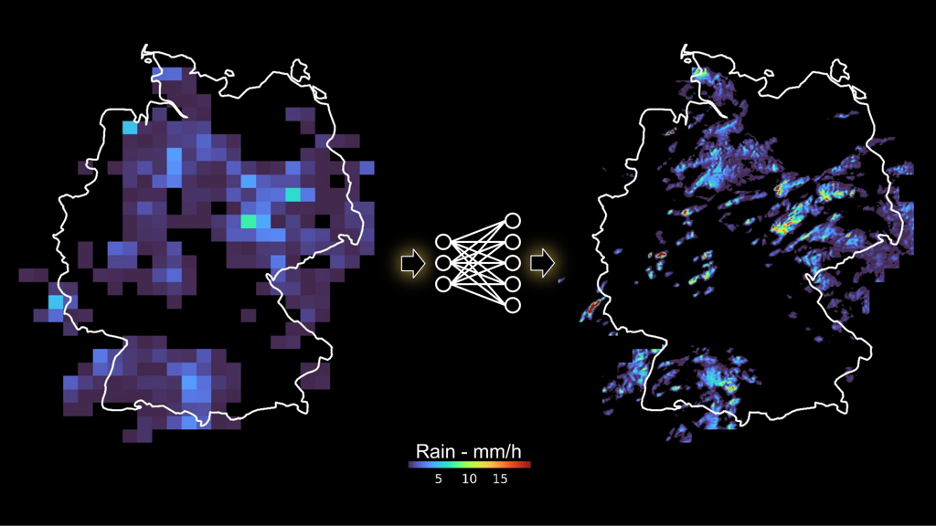
At KIT IMKIFU state of the art downscaling techniques are applied to refine the output of the climate models (scenic-DynAI). This includes dynamical downscaling using the weather research and forecasting model (WRF) and machine learning based approaches using the generative deep learning network spateGAN [1]. Thereby, deep learning methods have proven to be a valuable complement to traditional downscaling, as their calculation is significantly more resource-efficient.
SpateGAN is trained to simultaneously increase the resolution of precipitation information in time and space, using high resolution weather radar observations as target variable. Convective rainfall events, often completely missing in traditional climate model outputs, are reconstructed, which makes such a tool particularly useful for assessing localized hazards such as flash floods from information provided by climate simulations.
[1] Glawion, L., Polz, J., Kunstmann, H., Fersch, B., Chwala, C. (2023): spateGAN: Spatio-Temporal Downscaling of Rainfall Fields Using a cGAN Approach. Earth and Space Science. 10(10). e2023EA002906. https://doi.org/10.1029/2023EA002906.